 CanadaCAD
 United StatesUSD
 United KingdomGBP
 AustraliaAUD
 EuropeEUR
 Global—
Deskside


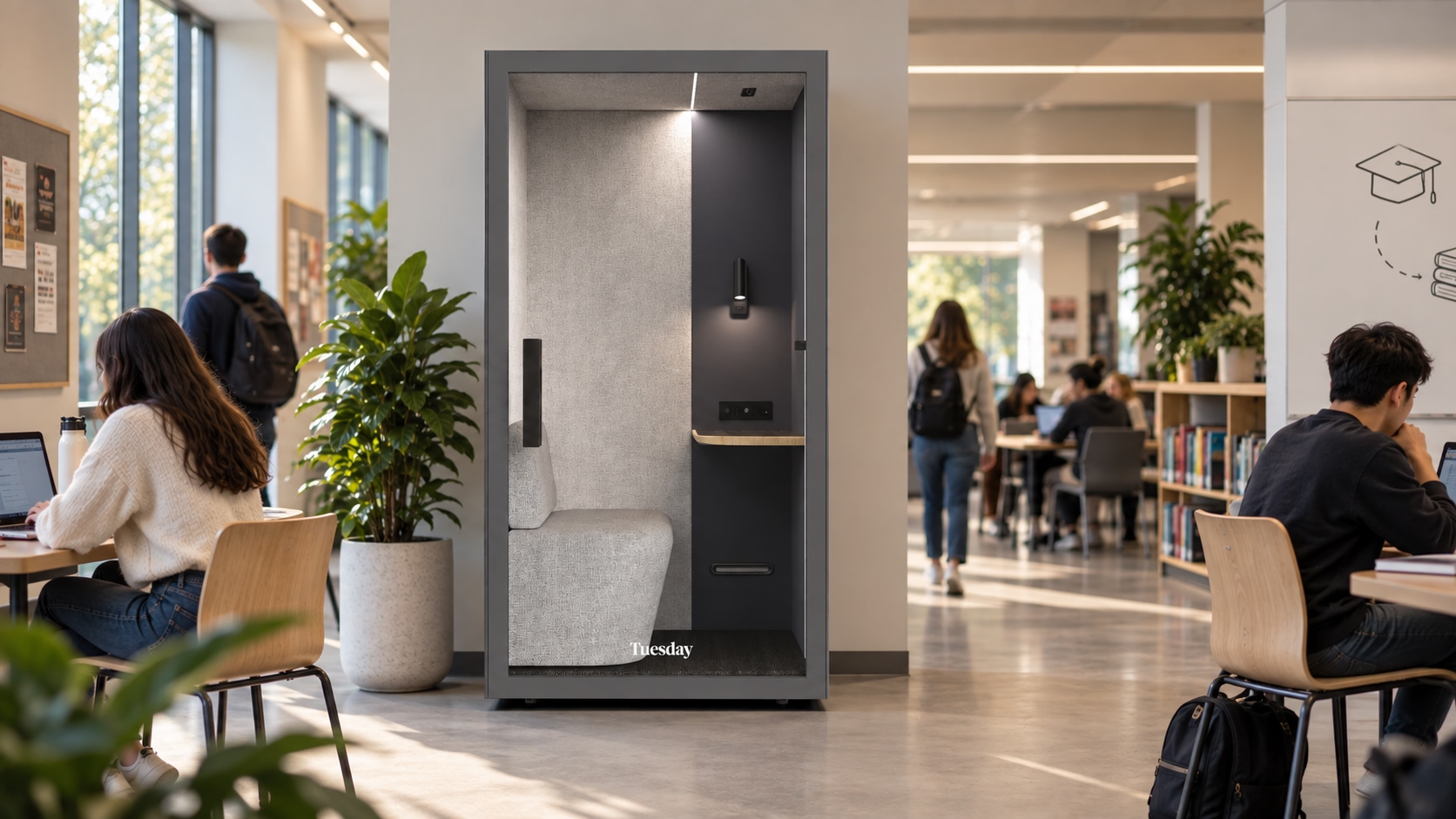
Schools use soundproof booths to create private, acoustically separated space inside rooms they already have. The five most common applications are individual focus space for students and staff, quiet study zones in noisy classrooms and libraries, low-distraction testing environments, accessible sensory and accommodation rooms, and dedicated space for self-paced or hybrid instruction. Because a booth is furniture rather than construction, institutions can add that space without permits, trades, or downtime.
So much about how students learn and what they need to thrive has evolved over the last couple of decades. As technology advances and learning objectives change, staff and institutions, from kindergarten classrooms all the way through higher education campuses, are looking for the most supportive ways to meet students where they are while also preparing for what comes next.
When it comes to providing that support, schools often find themselves trying to strike a delicate balance between giving students what they need and doing so cost effectively. Every investment an educational institution makes is important, so it is vital to make it count.
Soundproof booths are proving to be the best of both worlds: flexible enough to support all kinds of different learning styles, and, because they are furniture rather than construction, achievable without a capital works project. Here are the five ways these booths are transforming learning today.
Key Takeaways
- Soundproof booths give students and staff private, acoustically separated space inside existing classrooms, libraries, and campus buildings without new construction.
- Bureau’s Tuesday Series booths deliver up to 29 dB of speech level reduction, tested to ISO 23351-1, against an average measured classroom background noise of 49 dBA.
- EverGreen Early Learning Centre in Abbey, Saskatchewan uses two booths, one for students and one as a staff office that keeps sightlines to the room intact.
- Fraser Valley Regional Library, the largest public library system in British Columbia, has installed bookable booths across all 15 of its locations.
- Booths give students with testing anxiety or distraction sensitivity a private exam environment, and let instructors run make-up and proctored tests without leaving the class unsupervised.
- For students with cognitive disabilities or sensory needs, booths create accommodation space inside the classroom, avoiding the isolation that comes with removing a student from their peers. Accessible models built to comply with ADA Standards for Accessible Design are available in North America.
- Alpha School has ordered more than 100 Tuesday Series booths, roughly one for every 5 to 6 students, to support its self-paced instructional model.
1. How soundproof booths give students and staff private focus space
Classrooms are the original open office. Dozens of students, or hundreds in the case of some university lectures, are expected to sit, pay attention, and work in a room together without privacy. This model works for some people. For others it is the least conducive environment for finding focus imaginable. And it is not just students who suffer. Teachers and administrators often have no dedicated private space for anything from grading to one-on-one mentoring.
Classroom acoustic standards assume quiet. ANSI S12.60 recommends background noise in an unoccupied classroom stay under 35 dBA, roughly the level of a whisper. Occupied classrooms are nowhere near that. Lily Wang and Laura Brill at the University of Nebraska-Lincoln logged sound levels every 10 seconds across six full school days in 220 K-12 classrooms and found average non-speech noise of 49 dBA, with levels above 50 dBA for nearly a third of the school day. Analysing the same classrooms against standardized test results, they found higher daily non-speech levels correlated with lower math achievement scores, even after controlling for socioeconomic status.
Soundproof booths, with their range of sizes and customization options, are being used by schools and institutions at every level to provide the private space that students and staff need to get work done. EverGreen Early Learning Centre in Abbey, Saskatchewan brought two booths into their facility: one for students, and one for staff. Functioning as a dedicated office, the staff booth allows employees to tackle administrative work without distractions while maintaining sightlines to their young charges.
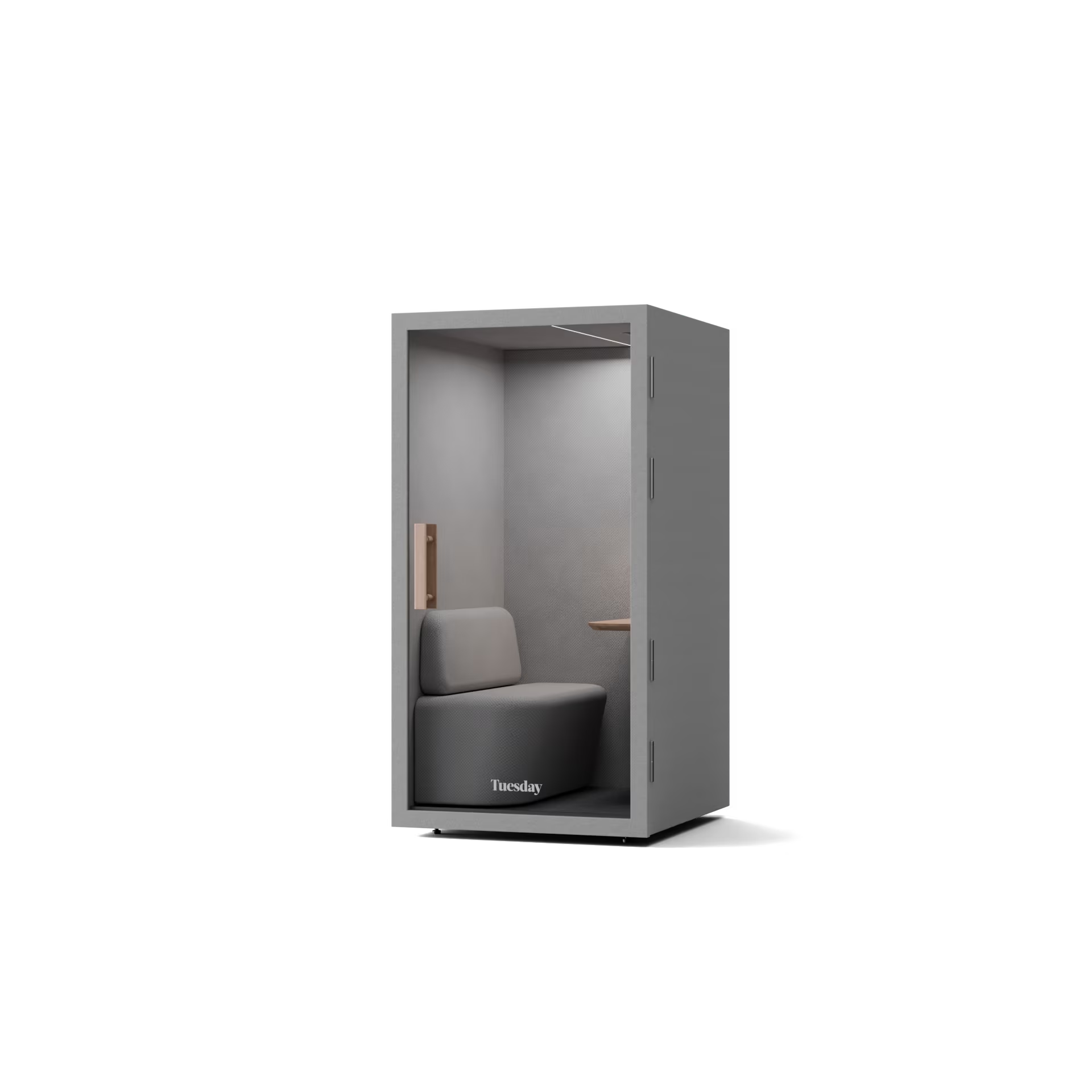
Single-person models such as the Tuesday, One Solo, and One+ Focus suit this use case, since they fit into corners and along walls without consuming teaching space.
2. Using soundproof booths to create quiet zones in noisy classrooms and libraries
Between lectures, group work, and general conversation, classrooms are noisy places. And if you have not been to a library in a while, you might be surprised to learn they are not the silent sanctuaries they used to be either. In school and public libraries alike, conversation is rarely discouraged the way it once was. That has been good news for collaboration, socialization, and programming, but it often means there is less quiet to go around.
By bringing in soundproof booths, many classrooms and libraries have found it is possible to give students and patrons the quiet they need without shunning the human connection they have worked to foster. Fraser Valley Regional Library, the largest public library system in British Columbia, has done exactly that, introducing soundproof booths across each of their 15 locations. The pods are bookable and allow users to read, study, and work in peace without worrying about how anyone else is using the library.
Bureau booths are tested to ISO 23351-1, the international standard for speech level reduction in furniture enclosures. Tuesday Series booths achieve up to 29 dB of speech level reduction, and Signature 2.0 up to 30 dB, placing them in Class B and Class A respectively. In a classroom averaging 49 dBA of background noise, that means a conversation inside the booth arrives outside well below the noise already in the room.
3. Soundproof booths as testing and exam rooms in schools
Tests and exams are a part of virtually every education system, and as important as they are, they can pose real problems in the classroom. For some students, sitting an exam in a full room is setting them up for failure. Whether it is testing anxiety or a need for fewer distractions, and who among us has not been thrown off when the first student stands up to hand in a completed paper, booths help take the edge off an already stressful experience for the students who need it.
Noise doesn’t just make testing unpleasant, it measurably changes results. Connolly and colleagues had 976 high school pupils read science texts and answer comprehension questions while exposed to recorded classroom noise. At 70 dB, a level measured in real lessons, pupils attempted fewer questions and answered less accurately than at 50 dB (Journal of the Acoustical Society of America, 2019).
Booths also solve a scheduling problem. For proctored exams, or when a student needs to sit a make-up test while the rest of the class works on something else, soundproofing and glass walls let that student test in privacy without being disturbed by peers and without requiring the instructor to be in two places at once.
4. How soundproof booths support accessibility and sensory needs in the classroom
The days of one-size-fits-all schooling are behind us. Many students have different needs that affect how they learn, and ensuring schools have spaces where students with cognitive disabilities or neurodivergence can work and decompress safely is essential to keeping education accessible.
This isn’t a small group of students. Federal data shows 7.5 million students ages 3 to 21 received special education or related services under IDEA in 2022-23, roughly one in seven public school students, up from one in eight a decade earlier. The most common category is specific learning disabilities.
In most classrooms, where one room is shared by many, carving out space to accommodate these needs is one of the biggest barriers to accessibility. A soundproof booth removes that barrier. Institutions use booths as dedicated sensory rooms, or as breakout space where students with accommodations can meet with mentors, therapists, and support workers. Beyond being quiet and private, booths make it possible to provide that space inside the classroom, eliminating the isolation and othering that comes with pulling a student away from their peers.
Physical access matters too. Bureau offers accessible booth models in North America, designed to comply with the ADA Standards for Accessible Design. For schools in the US and Canada, that means a student using a wheelchair can use the same booth as everyone else in the room rather than being routed to a separate space, which is the whole point of putting the accommodation inside the classroom in the first place.
5. Supporting hybrid and self-paced learning with soundproof booths
Curricula are becoming less uniform and more individualized, letting students be met where they are and learn at their own pace. Advances in technology have opened up hybrid instruction and alternative learning models in academic settings. But the traditional classroom is not built for self-paced work, and this is where soundproof booths do their most interesting work.
Alpha School has ordered more than 100 Tuesday Series booths to support its self-paced instructional model, at a ratio of roughly one booth for every 5 to 6 students. Rather than a handful of quiet rooms shared across a campus, that density means acoustic separation is available to a student whenever their personalized lesson calls for it, not only when a room happens to be free.

How to bring soundproof booths into your school
Every school’s needs look different, whether that’s two booths for staff and testing or a hundred for self-paced instruction. See how other institutions have approached it on our education page, compare sizes and configurations in the booth product guide, or visit a showroom to hear the difference for yourself.
Frequently asked questions
How many soundproof booths does a school need?
It depends on how the booths will be used. For self-paced or individual instruction, Alpha School has ordered more than 100 Tuesday Series booths, roughly one for every 5 to 6 students. For occasional use such as testing accommodations, staff calls, or bookable quiet time, one or two booths per floor or department is typically enough. Smaller facilities often start with two, as EverGreen Early Learning Centre did with one booth for students and one for staff. Library systems tend to scale by branch: Fraser Valley Regional Library placed booths in each of its 15 locations.
How quiet is a soundproof booth?
Bureau booths are tested to ISO 23351-1, the international standard for speech level reduction in furniture enclosures. Tuesday Series booths achieve up to 29 dB of speech level reduction and Signature 2.0 up to 30 dB, placing them in Class B and Class A respectively. For context, occupied classrooms average around 49 dBA of background noise, so a conversation inside the booth reaches the room at a level well below the noise already in it. The enclosure also reduces the classroom noise reaching the person inside.
Are soundproof booths safe for students to use without direct supervision?
Booths are built with full glass fronts, so staff keep visual sightlines to anyone inside, and the doors cannot be locked or secured from the inside. Every Bureau booth includes ventilation and lighting, with the number of fans and the presence of occupancy sensing varying by model. On certifications, the Tuesday Series is BIFMA compliant and the Signature Series 2.0 is GREENGUARD Gold certified for low chemical emissions, which matters in environments with children and prolonged occupancy. Supervision policy is set by the institution.
Do soundproof booths need special power or ventilation?
No construction or building services work is required. Booths run from a standard wall outlet and include their own ventilation and lighting.
Can soundproof booths be moved between classrooms?
Yes. Booths are modular and can be disassembled and relocated, which is a practical difference from built walls when enrolment, timetabling, or room use changes.
Are soundproof booths accessible for students with disabilities?
Bureau’s Focus Accessible and Meet Accessible models, available in North America, are designed to ADA dimensional standards so a wheelchair user can enter, turn, and settle in without assistance. Both have a full 60″ turning circle with no T-turn required, a step-free entry with the threshold under 1/2″ because there is no raised floor, and an easy-open manual door needing under 5 lbs of force with a 120° swing. Focus Accessible seats one, Meet Accessible seats up to four, and both share a 7′ 11″ × 6′ 2″ footprint. In Focus Accessible, the lighting and airflow controls are mounted within reach from a seated position. Beyond physical access, booths are widely used as sensory or decompression spaces for students with cognitive disabilities or neurodivergence.
Share article with your community!


Deskside