 CanadaCAD
 United StatesUSD
 United KingdomGBP
 AustraliaAUD
 EuropeEUR
 Global—
Deskside


Hugo Gernsback was a busy guy.
A lover of stories, science, and technology, Gernsback spent the early 1900s sharing those interests with the masses. He edited and published magazines dedicated to science fiction and broadcasting, with his contributions to the former being so significant that the Hugo Awards, the prestigious literary awards presented each year at the World Science Fiction Convention, were actually named after him. He was a writer, an inventor, and a radio station entrepreneur.
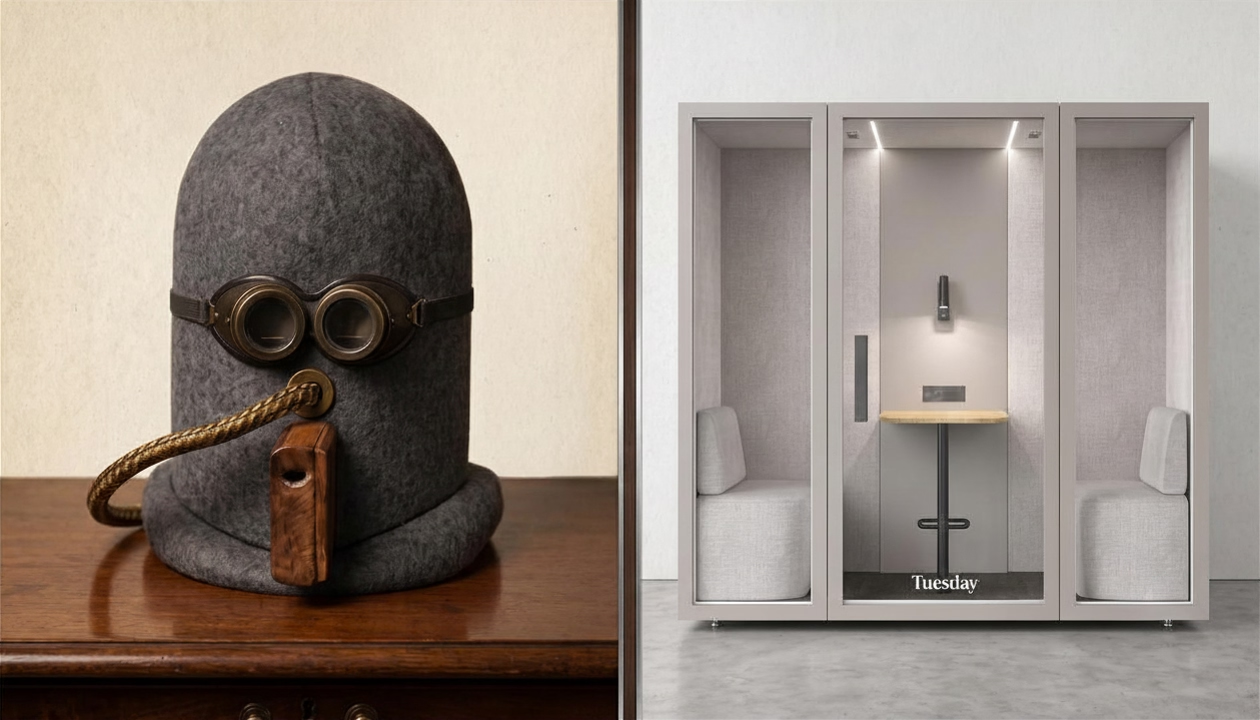
Passionate as he was, Gernsback also suffered from a problem familiar to most of us today: falling victim to endless distractions that made it hard to focus on his work. Frustrated (but also inspired), Gernsback developed a creative solution in 1925 that he dubbed the “Isolator” helmet. The device looked like an old fashioned diving helmet, with thick padding to dull noise and limited visibility that blocked out everything except what was directly in front of the wearer.
The Isolator helmet was an extreme, impractical, and ultimately doomed fix to wandering focus. Still, its very existence (however short-lived) tells us that the struggle to focus at work is hardly a new phenomenon.
But while we’ve been grappling with this problem for over a century, it seems we might be losing the fight for focus.
A quick search of the topic will deliver a seemingly endless list of posts and articles from others bemoaning their struggle to concentrate or exploring various hacks to make it easier to lock in. Some even go as far as calling the rise in focus-related difficulties as a full-blown crisis.
So, what’s changed? Because you’re not imagining things: it is harder to focus than it used to be. The question is: why?
Workplace values have shifted since the early days of office work
While some versions of offices have been around since the 1700s, it was the advent of electricity and the rise of white collar jobs that really set the stage for what we think of as offices today.
The physical office-based workplace underwent various evolutions throughout the 20th century as companies experimented with individual offices, cubicles, and partitions when setting up workstations. While these offices weren’t exactly quiet, the jangling of telephones and clacking of typewriters made sure of that, they offered employees a degree of privacy and personal space, even if it did come at the expense of easy collaboration between colleagues.
Then, in the early 2000s, something shifted. As the tech space boomed, then up-and-coming companies such as Google and Facebook leaned into the concept of open offices in a big way.
These companies filled large, open spaces with side-by-side workstations, which were often unassigned. The idea was to allow for more flexibility and greater collaboration; employees could sit wherever and with whomever suited them. Without walls, doors, or partitions, conversations could flow more easily and organically. Of course, it didn’t hurt that open offices were significantly cheaper to set-up and provided management with greater visibility of their teams, either.
What we keep rediscovering is that, when it comes to office spaces, one size never really fits all
These kinds of open offices were truly groundbreaking at the time they were first hitting the scene. Being able to see and easily interact with your colleagues felt like a real win for office culture, and the ability to move around as one’s mood or work required it seemed like a perfect antidote to feeling like the cubicle walls were closing in on you day after day.
That said, it didn’t take employees long to realize that there are plenty of drawbacks to this model, too. Without any meaningful division between workstations, noise travels far and loudly. It’s hard to focus on deep work when you can’t escape the five different conversations happening around you, no matter how relevant they are. (And, let’s be honest, they aren’t always “on topic”, are they?) In the same vein, privacy often feels like a luxury that only those with doors can enjoy. Important client calls and sensitive one-on-one conversations are a lot trickier to navigate when half of your team is sitting within earshot.
But if an uptick in noise and a lack of privacy was all we had to contend with, we probably wouldn’t be tossing around the word “crisis” when talking about our collective inability to find focus at work. In truth, the popularity of modern open offices is just one part of the problem. The other is right in front of you…
The technology meant to keep our heads above water may actually be dragging us down
It’s hard to imagine the workplace without email, which is why it was such a huge disruptor when it first infiltrated our offices. No longer did you have to walk to another workstation, pick up the phone, or arrange a meeting just to ask a question or collaborate with others. Email allowed us to accomplish all of this from the comfort of our desk, without having to utter a single word to anyone. It was, in short, a revelation.
Fast-forward a few decades and it’s almost funny to think that email sometimes feels like one of the least effective ways to communicate with our colleagues. Why send a query that’s likely to languish in someone’s inbox when you could message them on WhatsApp or ping them on Slack? Those insistent notifications are sure to get their attention much faster.
Regardless, whether it’s email or a messaging app, instant communication tools have become indispensable at work. But while most of us can hardly imagine how we’d do our jobs without them, the ability to quickly and easily reach one another – any place, any time – has had serious ramifications for our ability to maintain focus. Even if you choose to ignore them in the moment, every notification you clock can be considered an interruption. According to research by Dr. Gloria Mark, it takes an average of 23 minutes and 15 seconds to get back on task after any kind of interruption, big or small. You don’t have to be good at math to understand how quickly those little breaks in your flow can eat away at your day.
All of this is on top of our varying levels of addiction to our personal devices outside of work, and the siren song of social media and other apps. At this point it’s no secret that social algorithms have been designed to grab our attention and hold on tight, rewarding our time spent on them with hits of sweet, sweet dopamine. The fact that they’re hard to look away from is intentional, which is why so many of us find ourselves reflexively reaching for our phones – and interrupting ourselves in the process – throughout the day.
Post-pandemic connectivity has turned our time into a precious resource that everyone has access to
The Covid19 pandemic was a real testament to our collective ability to adapt. With many of us forced into remote work, we turned to technology to keep us connected. While tools such as shared calendars and virtual meetings existed before lock down, the pandemic ensured that even the least tech savvy of us understood that Zoom was more than a verb.
Despite the majority of us now being back in the office at least part time, these tools have remained engrained in our business routines and, in turn, have skewed expectations on our time throughout the workday.
Meetings used to require having everyone physically in the same room, which typically meant we were a bit more judicious with what needed to be a meeting, when they happened, and who was invited. But in a world of virtual meeting spaces, attendees can be anywhere and the capacity of the meeting room no longer factors into the equation. And, while shared calendars certainly make scheduling meetings easier, they’ve also made it harder to protect our time. How many times have you logged in to find a new meeting dropped into the one block of focus time in your day? Now that “no events scheduled” has become synonymous with “free”, our time rarely belongs to us alone anymore.
Regaining focus will require changing how we approach nearly every part of working in a modern office
Just as there is no single root cause to why we struggle to focus at work, there is also no one magic fix for the problem. Our attention is being attacked at virtually every turn: from the way our offices are designed to the tools we use to do our jobs.
As individuals, we have a certain degree of agency in this fight. We can take steps to protect our focus and our time; establish communication expectations with colleagues, turn off notifications (and our phones), block off time in our calendars.
But some of the responsibility falls outside of our control, and will need to be tackled on a larger scale. This means reimagining the ways in which our offices function and intentionally creating physical spaces and company-wide policies that prioritize focus and deep work, without compromising the value and importance of collaboration and culture.
Daunting as that may sound, the challenge is worth pursuing. Our work, and our ability to get it done, depends on our willingness to take focus seriously, and to make protecting it a priority.
Ready for a focus fix that won’t make you look like a 1920s inventor?
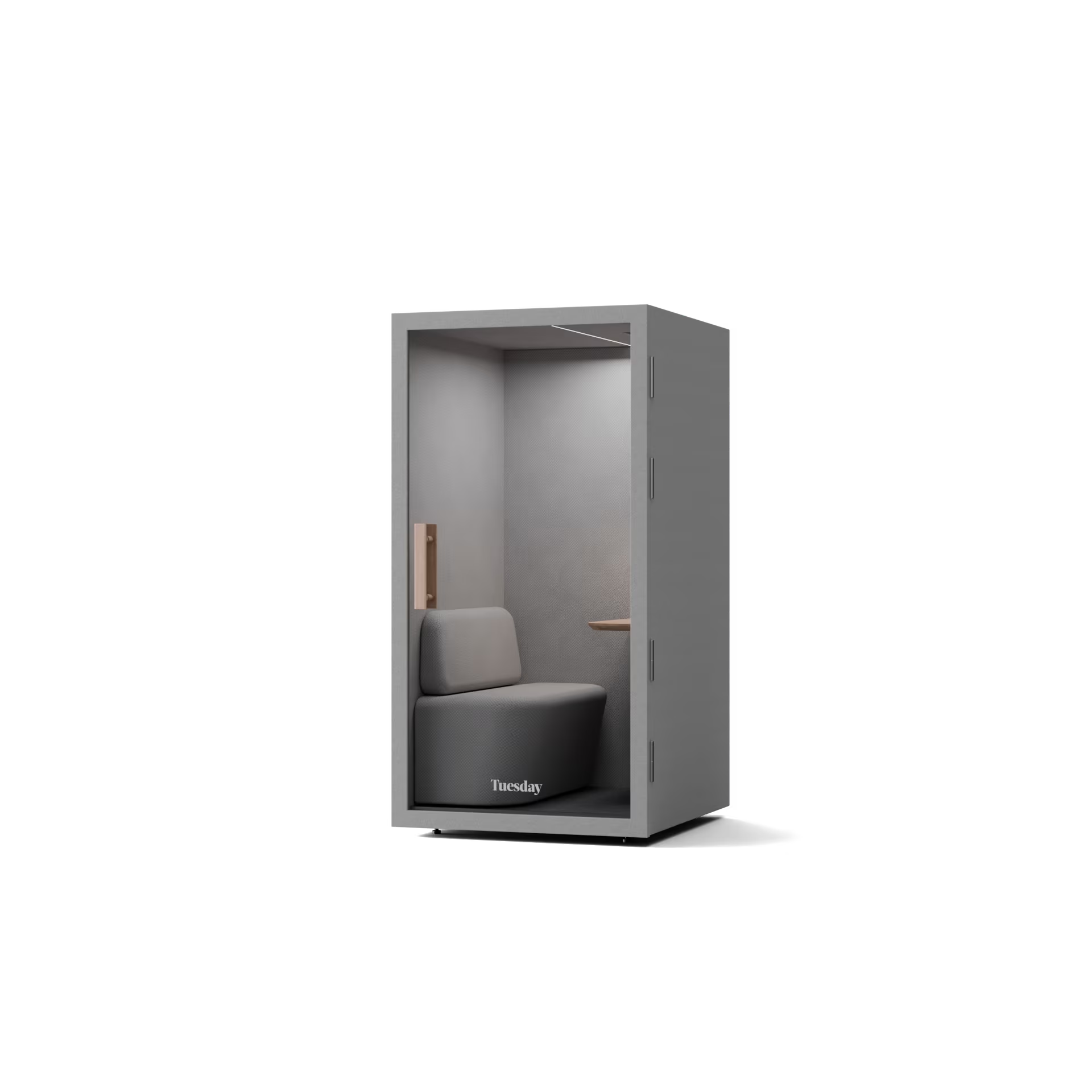
The Isolator helmet may have been ahead of its time, but thankfully, so are we. If open offices and endless notifications are making deep work feel impossible, Bureau booths give you a private, soundproof space to think, focus, and get things done, no bulky headgear required. Explore our line of Bureau booths and find the right fit for your team.
Share article with your community!


Deskside