 CanadaCAD
 United StatesUSD
 United KingdomGBP
 AustraliaAUD
 EuropeEUR
 Global—
Deskside

A Day in the Life of Office Distractions

By Laura Gannon
Global Brand Strategist
You arrive at 8:57 with a dose of motivation (or caffeine). Coffee (#3) in hand.
Laptop charged. The calendar is mercifully light. Today is the day you’ll finally finish the proposal, write the strategy, build the model, or whatever it is you do to pay the bills.
At 9:03, someone says your name. Not loudly. Just enough.
At 9:07, Slack pings.
At 9:11, your inbox hits 17 unread.
At 9:14, a colleague leans over your screen: “Quick one; won’t take a tick.”
It takes seven minutes.
By 10:30, you’ve technically been at work for 93 minutes. You’ve completed exactly zero deep tasks. If this feels familiar, it’s because it is.
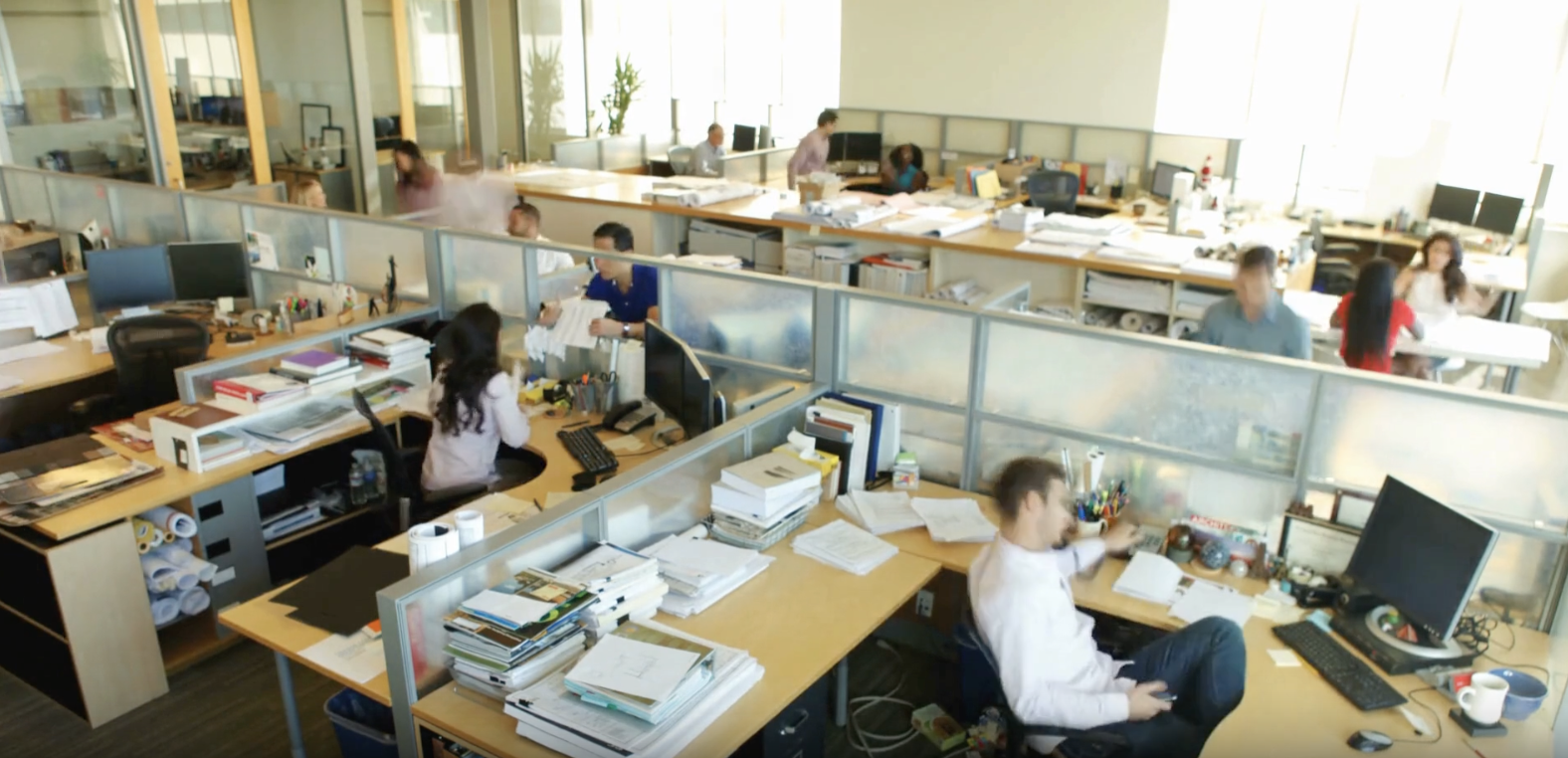
For most of us, the modern open-plan office is less a workspace and more a live broadcast of everyone else’s day. And your brain is front row.
The Myth of “Being in the Office = Being Productive.”
Open offices were designed for collaboration. Transparency. Energy. “Accidental innovation.”
What we got was an acoustic democracy where everyone hears everything.
The sales call is three desks down. The “quick catch-up” lasts 28 minutes. The keyboard warrior types like they’re filing a police report. The 10:47 microwave buzz and ring (the late-porridge colleague).
Ambient noise, layered with digital noise, layered with social noise: none of it is catastrophic. But it’s all cumulative.
The “Quick Questions” Culture
The open office runs on approachability.
“Got a sec?”
“Can I just run something by you?”
“While I’ve got you…”
These daily exchanges seem harmless. Collegial, even. But every pivot has a cognitive cost.
Your brain is forced to park the original task, load a new context, process, return, and reconstruct where you were. That reconstruction phase is the silent tax. It’s not visible, not measured, and rarely acknowledged.
Still, by mid-afternoon, you feel exhausted, despite not having produced the one thing you meant to. You turn into cognitive fatigue in a tailored blazer.
Notifications: The Attention Economy at Your Desk
Your phone vibrates. Slack flashes. Email previews glow in the corner of your screen like impatient toddlers. Even if you don’t respond, your brain registers the cue.
We like to think we’re good at ignoring distractions. We’re not. Attention is porous, and each alert is a tiny open loop. Checking the message takes up mental bandwidth. Not checking? You’re anticipating it. Lost momentum either way.
In a landmark study from the University of California, Irvine, researcher Gloria Mark found that after an interruption, it takes an average of 23 minutes and 15 seconds to return to the original task. Not to glance back at it, but to properly re-engage. And in most office environments, interruptions don’t arrive hourly. They arrive every few minutes.
Her research also showed that knowledge workers switch activities roughly every three minutes. Three. That’s cognitive hopscotch.
Then there’s the email effect. A study conducted at the University of London found that constant email interruptions temporarily lowered IQ by up to 10 points: more than the impact of a sleepless night. Working memory overloads, and the brain burns glucose simply by managing context shifts.
None of this feels catastrophic at the moment. But, stacked together, these interruptions erode the condition complex work depends on.
The Open-Plan Matter
Open-plan offices increase this effect. A Harvard Business School study examining face-to-face interaction after companies moved to open offices found something counterintuitive: in-person interaction dropped by around 70%, while digital communication increased. When people feel exposed, they retreat into headphones and screens. Yes: transparency breeds withdrawal.
We then wonder why everyone feels busy and behind.
Cognitive science has a name for this steady erosion: attention residue. When you switch tasks, part of your mind stays attached to the previous one. It lingers. That residue reduces performance on whatever follows. And the brain doesn’t wipe clean. It carries traces.
By 3:17 pm, you’re not just tired. You’re layered. Half-finished thoughts stacked on top of half-finished tasks. No clean edges anywhere.
This is where the environment becomes decisive.
When you step into a truly quiet space — enclosed, acoustically controlled, visually contained — the psychological state shifts. Cortisol lowers. Heart rate steadies. The brain exits scanning mode and stops monitoring the room for signals.
In this context, silence is not a lack of activity. It’s the removal of competition.
That’s why focused spaces inside open offices aren’t indulgences, but infrastructure, reintroducing a boundary of modern work quietly erased. A door. A wall. A signal that says: for the next 45 minutes, attention is not communal property.
We don’t need eight hours of isolation. Research suggests that even 60–90 minutes of uninterrupted concentration can materially increase output quality. One protected block can recover our entire day’s drift.
The open office isn’t the villain. Collaboration still matters. Energy matters. Serendipity matters.
But so does depth.
The modern workplace has optimized for visibility. The next evolution is intentional privacy. Not to disconnect from colleagues, but to reconnect with the work itself.
Because most people aren’t failing at focus.
They’re fighting their environment.
At Bureau, we build the infrastructure of concentration. Our pods are designed to silence the “acoustic democracy” of the open office, giving your team the 60–90 minutes of depth they need to actually move the needle.
Reclaim your workday.
Share article with your community!


Deskside